

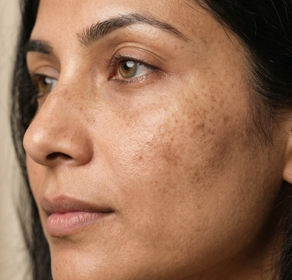
Types of Pigmentation
Melasma
One of the more challenging types to treat, because its internal hormonal driver keeps stimulating melanin even as active treatment clears the surface. Sun exposure consistently worsens it, so a comprehensive plan that manages this recurring cycle is necessary for lasting improvement.
Sunspots and Age Spots
Accumulate over years of unprotected sun exposure and tend to deepen with age. Structurally distinct from melasma, they typically respond very well to focused laser toning.
Post-Inflammatory Hyperpigmentation (PIH)
Extremely common in Indian skin, which naturally carries a higher baseline melanin level and marks more readily after any inflammation. PIH generally clears more easily than structural pigmentation when treated with the right balance of peels and lasers.
Uneven Skin Tone
A more diffuse form of pigmentation — patches lighter or darker than surrounding skin rather than distinct spots — caused by sun exposure, pollution, hormonal change, and age. Responds well to a combination of surface and dermal-layer treatment.
Loss of Radiance
Skin loses natural luminosity with accumulated sun damage, dehydration, and a slowing renewal cycle. Not pigmentation in the strict sense, but treated with overlapping technologies — HydraFacial, Laser Genesis, and chemical peels that accelerate renewal and clear the surface.
Pigmentation & Tone Correction Treatments


FAQs
Is melasma permanent?
Melasma is a chronic condition driven by internal hormonal factors, meaning it can recur if that internal trigger stays active. However, it is entirely manageable. By combining clinical laser toning, targeted peels, and strict daily sun protection, we can significantly fade the patches and keep the condition beautifully controlled over the long term.
What is the best treatment for dark spots on Indian skin?
Indian skin requires a non-ablative and highly precise approach. Aggressive, ablative treatments carry a major risk of triggering worse post-inflammatory pigmentation (PIH) in darker skin tones. At AAYNA, our absolute preferred treatments are MedLite Laser Toning, Hollywood Laser Toning, and medical-grade chemical peels—all of which are proven safe and effective across the entire spectrum of Indian skin tones.
How many sessions does pigmentation treatment require?
Every skin profile is unique, but general timelines include:
- Sun spots: 2 to 3 sessions usually clear them.
- Surface PIH: 3 to 4 sessions of laser toning typically yield significant improvement.
- Melasma: Usually requires a full course of 6 to 8 sessions followed by a customized maintenance plan.
Note: Exact timelines are always finalized during your initial personal consultation after we map the precise depth of your pigment.
Can pigmentation return after treatment?
Sun-induced spots can return if sun protection is skipped, and melasma needs active maintenance given its hormonal nature. PIH, on the other hand, typically doesn’t return to the same spot unless that area experiences fresh injury or a new breakout.
Is sunscreen necessary after laser toning?
Unambiguously, yes. Any treatment that shatters or targets melanin makes your skin temporarily more vulnerable to UV rays. Going unprotected out in the sun will prompt your cells to produce new pigment rapidly to defend themselves. Applying an SPF 50 daily and reapplying it every 2 to 3 hours is our mandatory, non-negotiable aftercare standard.
Can hyperpigmentation be treated during pregnancy?
AAYNA doesn’t perform medical chemical peels or laser treatments during pregnancy, as a precaution. The safest approach is diligent sun protection throughout pregnancy, with targeted clinical treatment scheduled for the postpartum period.
Is there such a thing as a permanent skin lightening treatment?
Not quite, and any treatment claiming absolute permanence should be treated with caution. Pigmentation, especially melasma, can be dramatically and lastingly faded, but new sun-induced pigmentation can form without ongoing protection. The realistic goal of a permanent skin lightening treatment is long-term, well-managed clarity, maintained with daily SPF, not a single procedure that guarantees pigmentation never returns.
What's the best skin lightening treatment for dark spots on Indian skin?
Indian skin needs a non-ablative, precise approach — aggressive, ablative treatments carry real risk of triggering worse PIH in darker tones. At AAYNA, MedLite Laser Toning, Hollywood Laser Toning, and medical-grade chemical peels are the preferred skin lightening treatments, proven safe and effective across the full spectrum of Indian skin tones.
How much does pigmentation treatment cost at AAYNA?
Pigmentation treatment cost and pigmentation treatment price depend on which type is diagnosed and how many sessions your plan needs — melasma typically requires more sessions than sun spots. Your dermatologist and aesthetic physician confirms exact pricing once your pigment has been mapped.
What Our Patients Say




Plan Your Visit


AAYNA, Khan Market
- 47, Middle Lane, Rabindra Nagar, Khan Market, New Delhi – 110003
- +91 987 039 6667


AAYNA, Gurugram
- Ground Floor, 16 &17, Golf Course Rd, DLF Phase 1, Sector 27, Gurugram, Haryana - 122002
- +91 981 092 7946


Book Your Consultation Today
Take the first step towards healthier skin and confident beauty.