
Types of Unwanted Hair
General Facial and Body Hair
Largely a matter of personal preference and daily convenience. Hair grows in the usual areas — arms, legs, underarms, back, abdomen, face, and intimate areas — and while the follicles function normally, the pace of regrowth makes temporary removal unsustainable long-term.
Hirsutism (Hormonally Driven Hair Growth)
Hirsutism is the excessive growth of thick, dark hair in a male-pattern distribution on a female body. This growth occurs specifically in androgen-sensitive areas, including:
- The upper lip and chin
- The chest and upper back
- The lower abdomen and inner thighs
This condition is triggered when the body produces elevated levels of circulating androgens (male hormones present in all women) or when the hair follicles themselves are hypersensitive to normal androgen levels. Hirsutism is a hallmark symptom of Polycystic Ovary Syndrome (PCOD), though it can also stem from a hereditary predisposition without an underlying medical condition. Clinically, its severity is assessed using the Modified Ferriman-Gallwey Scale, which evaluates hair density across nine specific body areas to help determine if medical intervention is required alongside topical technologies.
Unwanted Face & Body Hair Treatments

FAQs
Is laser hair reduction safe for Indian skin tones?
Yes. Older laser technologies often struggled to differentiate between the melanin in the hair and the melanin in darker skin. The advanced Soprano Titanium system used at AAYNA solves this by allowing specialized, individual calibration for deeper Indian complexions, ensuring maximum hair destruction with complete safety for the surrounding skin.
How many sessions are required?
Most areas require 6 to 8 sessions spaced 4 to 6 weeks apart to achieve optimal results. The exact number varies depending on the targeted body zone, hair density, texture, and individual hormonal factors. A customized timeline is provided during your initial consultation.
Is the treatment painful?
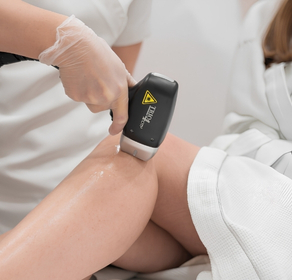
Unlike traditional lasers or the painful pull of waxing, the Soprano Titanium is highly tolerable. Its specialized in-motion technology and continuous cooling tip sweep across the skin smoothly, reducing discomfort. Most clients report feeling nothing more than a mild, predictable sensation of warmth.
Can laser hair reduction address PCOD-related hair growth?
Absolutely. Laser treatment is highly effective at reducing the coarse, visible hair caused by PCOD. However, because PCOD creates an internal environment that continuously tries to stimulate new hair follicles, individuals with this condition may require a few additional initial sessions and periodic, long-term maintenance appointments.
Is the reduction permanent?
The treatment delivers a long-term, clinically significant reduction of up to 90% of body hair rather than absolute, literal permanence. Following a full course, any remaining hair becomes sparse, exceptionally fine, and practically unnoticeable. For individuals with underlying hormonal drivers, an annual maintenance session is recommended to sustain the smooth results.
Which areas of the face and body can be treated?
The technology can safely treat virtually any area of the body. This includes the upper lip, chin, full face, underarms, arms, legs, back, abdomen, bikini line, and sensitive intimate zones. A standard full-body session is highly thorough and takes approximately two and a half hours to complete.
What is hirsutism, and how is it different from ordinary unwanted hair?
General unwanted hair is a matter of preference — it grows in typical areas and responds predictably to removal methods. Hirsutism in women is different: it’s an excessive, male-pattern growth of thick, dark hair driven by elevated androgens or follicles unusually sensitive to normal hormone levels, and it often needs to be understood, not just removed.
What causes hirsutism, and is PCOS always the reason?
PCOS hirsutism is the most common driver, but hirsutism causes also include other hormonal conditions and, in some cases, a hereditary predisposition without any underlying disorder. Severity is assessed using the Modified Ferriman-Gallwey Scale, which your dermatologist and aesthetic physician uses to decide whether a wider medical work-up should run alongside cosmetic treatment.
Can I remove unwanted facial hair without addressing the hormonal cause?
Yes, cosmetically — laser hair reduction reduces the visible hair regardless of cause. But if hirsutism in women is left undiagnosed, the hormonal driver keeps stimulating new follicles, so hair reduction alone may need more frequent maintenance than it would for non-hormonal hair growth. Your dermatologist and aesthetic physician flags this at consultation rather than treating every case identically.
What is the actual treatment for unwanted hair and hirsutism at AAYNA?
Laser hair reduction with the Soprano Titanium system is used across every case, calibrated to your skin tone, hair density, and area. For full technology details, session counts, and pricing, see AAYNA’s dedicated Laser Hair Reduction (LHR) page — this page focuses on identifying what’s actually driving your hair growth before you book that treatment.
Is hirsutism a sign of a bigger health issue?
It can be. Hirsutism in women is a hallmark symptom of PCOS, so persistent, male-pattern hair growth is worth a proper diagnostic conversation, not just a cosmetic fix. Your dermatologist and aesthetic physician will flag if a wider medical evaluation is warranted.
Which AAYNA clinics can assess unwanted hair and hirsutism?
All four AAYNA clinics — Delhi (SDA and Khan Market), Gurugram, and Ludhiana — offer this assessment, with laser hair reduction available on-site once your plan is confirmed.
What Our Patients Say




Plan Your Visit


AAYNA, Khan Market
- 47, Middle Lane, Rabindra Nagar, Khan Market, New Delhi – 110003
- +91 987 039 6667


AAYNA, Gurugram
- Ground Floor, 16 &17, Golf Course Rd, DLF Phase 1, Sector 27, Gurugram, Haryana - 122002
- +91 981 092 7946


Book Your Consultation Today
Take the first step towards healthier skin and confident beauty.