

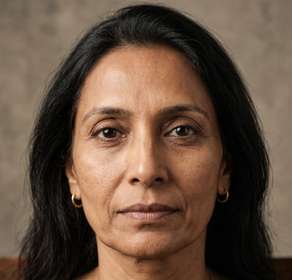
How the Face Ages
Collagen and elastin loss:
Collagen and elastin production begins its gradual decline from the mid-twenties, though most people don’t notice until the mid-thirties, when skin starts losing its ability to spring back. Fine lines appear first at the corners of the eyes and across the forehead; static lines, visible even at rest, follow as the tissue continues to thin.
Volume loss:
Often the earliest visible change, and the one most people misread as tiredness rather than ageing. The under-eye area hollows first, followed by the mid-face and cheeks — as that volume goes, the lower face appears comparatively heavier, contributing to jowling along the jawline.
Skin laxity:
Reduced structural support combined with gravity causes soft tissue to descend over time. The youthful V-shape of the face gradually gives way to a squarer, heavier lower third, with the same laxity often visible across the neck and décolletage.
Skin texture and tone:
Cumulative sun exposure, hormonal change, and years of accumulated damage show up as uneven pigmentation, enlarged pores, and a dullness that topical skincare alone cannot resolve — the textural layer most anti-ageing facial treatment plans need to address alongside structural correction.
Anti-aging Treatments


FAQs
When should I start anti-ageing treatments?
There is no single right age. The most productive approach is preventive: starting collagen-stimulating treatments before significant laxity develops preserves the structure that makes results natural. Many clients in their thirties begin with treatments such as Botox, ClearLift, or Laser Genesis, which maintain skin quality progressively. The more significant treatments, including Thermage and fillers, become relevant as structural changes begin to appear. A consultation at AAYNA will give you an honest picture of what is useful now and what can wait.
What is the difference between Thermage and Ultherapy?
Both stimulate new collagen and produce skin tightening. Thermage uses monopolar radiofrequency and treats the skin and connective tissue layer, making it suited to overall laxity, surface skin quality, and the eye area. Ultherapy uses focused ultrasound and targets the deepest structural layer, the SMAS, which is the layer addressed in surgical facelifts. Ultherapy is the stronger lifting technology. Thermage produces a broader improvement in skin firmness and texture. The right choice depends on what the face needs. Sometimes both are used in sequence.
Are fillers and Botox safe for Indian skin?
Both are well-established internationally and are used safely across all skin tones, including Indian skin types. The consideration for Indian skin is placement and product selection. At AAYNA, filler placement is guided by facial anatomy and the natural proportions of the individual. Botox dosage is calibrated to the individual’s muscle mass. Both are delivered by experienced medical specialists.
How natural do the results look?
This depends on what is done and how it is done. The AAYNA approach is conservative by philosophy: the aim is to look like yourself, rested and restored, not to look as though something has been done. The combination of volume restoration, structural support, and skin quality treatment, planned and sequenced correctly, produces a result that most people describe as looking well, not treated.
Is there downtime with anti-ageing treatments?
Most treatments at AAYNA involve very little downtime. Botox and fillers produce mild swelling or bruising that resolves within a few days. Thermage and Ultherapy involve no recovery. AAYNA Renew involves twenty-four to forty-eight hours of redness. Medical facials and ClearLift require none at all. Your specialist will outline exactly what to expect before any treatment begins.
How long do results last?
This varies by treatment. Botox lasts four to six months. Fillers last twelve to eighteen months depending on the product and area. Thermage and Ultherapy produce results that develop over months and are generally sustained for one to two years. Skin quality treatments such as ClearLift and AAYNA Renew are most effective as an ongoing maintenance programme, typically two to four sessions per year.
Is wrinkle treatment a one-time fix, or does it need to be repeated?
Ageing is an ongoing process, so no single anti wrinkle face treatment session halts it permanently. A well-planned course delivers a significant, lasting improvement that is then maintained with periodic sessions — typically once or twice a year — rather than one procedure expected to hold indefinitely.
What is the right anti-ageing facial treatment for early fine lines versus deep, static wrinkles?
The two need different approaches. Early, dynamic lines that appear only when you move your face respond well to preventive options like Botox or ClearLift, which maintain skin quality progressively. Once wrinkles are visible even at rest, that usually signals structural change, and anti-aging facial treatments such as Thermage, Ultherapy, or dermal fillers become more relevant. Your dermatologist and aesthetic physician confirms which stage you’re at during consultation.
How many sessions does a full anti-ageing treatment plan typically involve?
This depends entirely on which layer is being addressed. Botox and dermal fillers are typically single-session treatments repeated every four to six months (Botox) or twelve to eighteen months (fillers). Collagen-stimulating treatments like Thermage and Ultherapy are usually one session with results developing over months. Skin-quality treatments such as ClearLift are most effective as an ongoing programme of two to four sessions a year.
Will wrinkles and sagging come back after treatment?
The ageing process doesn’t pause because you’ve had a treatment, so some gradual return of the underlying concern is expected. This is why anti-ageing at AAYNA is planned as a long-term programme rather than a single intervention — periodic maintenance keeps results looking rested and current.
Does skincare or sunscreen matter if I'm getting professional wrinkles treatment?
Significantly. Daily broad-spectrum sunscreen is non-negotiable — unprotected UV exposure actively degrades collagen and accelerates the texture and tone changes these treatments correct. A consistent, dermatologist-guided home skincare routine also extends the visible results of in-clinic anti-aging facial treatments between sessions.
Is anti-ageing treatment safe if I have sensitive or reactive skin?
Yes, with the right sequencing. If you have an underlying sensitivity or barrier concern, your dermatologist and aesthetic physician typically stabilises that first before introducing more active anti-ageing facial treatment, to avoid provoking irritation. This is decided at consultation, not assumed from a standard protocol.
What Our Patients Say




Plan Your Visit


AAYNA, Khan Market
- 47, Middle Lane, Rabindra Nagar, Khan Market, New Delhi – 110003
- +91 987 039 6667


AAYNA, Gurugram
- Ground Floor, 16 &17, Golf Course Rd, DLF Phase 1, Sector 27, Gurugram, Haryana - 122002
- +91 981 092 7946


Book Your Consultation Today
Take the first step towards healthier skin and confident beauty.