
Types of Acne & Marks
Whiteheads & Blackheads (Comedones)
Closed and open blocked follicles without active infection. Left alone, these are usually the precursor stage to inflammatory acne.
Papules & Pustules
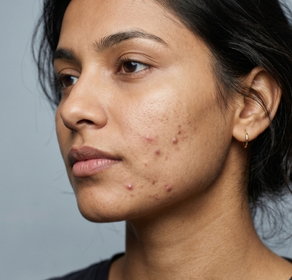
Inflamed, raised lesions signalling bacterial activity within the follicle — papules present as firm red bumps, pustules carry visible pus at the tip.
Nodules & Cysts
Deeper, more severe acne. Nodules are painful, solid lumps beneath the surface; cysts are larger and fluid-filled. These are the lesions most likely to leave permanent scarring.
Atrophic (Depressed) Scars
The most common structural scar from inflammatory acne, caused by a loss of tissue volume in the dermis.
Post-Inflammatory Hyperpigmentation (PIH)
Flat, dark or red marks left behind once a breakout heals. Especially common in Indian skin tones, PIH is a pigmentation issue rather than true scar tissue, and typically clears more readily than structural scarring.
Hypertrophic & Keloid Scars
Raised, firm scars formed when the skin’s healing response produces excess collagen. Less common with acne than with other injuries, but they do appear, most often on the jaw, shoulders, and chest.
Active Acne & Marks Treatments


FAQs
Why does my acne keep coming back despite trying many treatments?
Recurring acne typically points to an unaddressed internal or environmental driver. The most common cause is hormonal influence (such as elevated androgens related to PCOD or menstrual cycles), which topicals cannot fix. Other causes include an impaired skin barrier from over-cleansing, unresolved deep dermal inflammation, or the subconscious use of comedogenic skincare and makeup products.
Is acne and scar treatment safe for Indian skin tones?
Yes. Indian skin tones are highly prone to post-inflammatory hyperpigmentation (PIH) if treated with aggressive, surface-ablating technologies. At AAYNA, specialists utilize advanced, depth-controlled, and non-ablative technologies (such as MNRF and Nd:YAG lasers) that safely protect the epidermis while correcting deeper issues across all skin tones.
Should I treat my active acne first or address the scars?
Active acne almost always needs to be stabilised before scar revision begins — treating scars on actively inflamed skin limits results and risks creating new marks. If breakouts are mild, some plans can address both concurrently, which your specialist judges case by case.
Can acne scars be fully removed, or only improved?
Meaningful, visible improvement is realistic — typically a significant reduction in scar depth and texture after a full treatment course — but complete removal, particularly of deep ice-pick scars, isn’t a claim any credible acne scar treatment can honestly make. The goal is smoother, more even-textured skin, not an erased history.
How many sessions are needed, and is there downtime?
- Active acne and PIH typically need three to four sessions spaced a few weeks apart, several with no downtime at all.
- Structural scar revision generally requires four to six sessions of a course like AAYNA Renew, spaced three to four weeks apart, with mild redness for twenty-four to forty-eight hours after each session.
Can hormonal acne be treated without oral medication?
If the hormonal component is mild or cyclical, it can often be successfully managed through tailored in-clinic treatments (like Laser Genesis or AAYNA Miracle), specific topical serums, and skin barrier support. For severe or persistent systemic hormonal acne, a combination of medical management and targeted in-clinic procedures yields the best outcome.
Does acne treatment require a long-term commitment?
Because acne is a chronic condition for many, long-term success involves two phases: an initial active treatment phase to clear the skin and revise tissue damage, followed by a less intensive, periodic maintenance protocol. The ultimate objective is to guide the skin into a predictable, self-sustaining state that does not require constant clinical intervention.
What is the best acne scar treatment for Indian skin tones?
Indian skin is more prone to post-inflammatory hyperpigmentation, so aggressive, ablative technologies carry real risk of making pigmentation worse. At AAYNA, depth-controlled, non-ablative options like MNRF Microneedling with Radiofrequency and Nd:YAG-based lasers are generally preferred, since they correct deeper structural change while protecting the surface across all skin tones.
How much does acne scar treatment cost at AAYNA?
Cost depends on scar depth, the technology used, and how many sessions your treatment for acne scars requires — a course of MNRF is priced differently from a series of chemical peels. Your dermatologist and aesthetic physician lays out a transparent, itemised cost once your scarring has been properly assessed.
I'm searching for acne treatment near me — where can I be seen?
AAYNA has acne and acne-scar specialists across all four clinics — Delhi (Safdarjung Development Area and Khan Market), Gurugram, and Ludhiana — so acne treatment near me is available at whichever location is closest to you.
What Our Patients Say




Plan Your Visit


AAYNA, Khan Market
- 47, Middle Lane, Rabindra Nagar, Khan Market, New Delhi – 110003
- +91 987 039 6667


AAYNA, Gurugram
- Ground Floor, 16 &17, Golf Course Rd, DLF Phase 1, Sector 27, Gurugram, Haryana - 122002
- +91 981 092 7946


Book Your Consultation Today
Take the first step towards healthier skin and confident beauty.